TEAM
Founder
Product Designer (Me)
Software Engineer
Social Media Lead
PROJECT TIMELINE
4 months
OUTCOMES
8% daily active users
~6% goals achieved
~10% NPS
LINKS
Our team’s success metric for daily active user rate, increased goal achievement with NED’s support, and NPS driven by user referrals highlight the positive impact on engagement and motivation.
CHALLENGE
How can we make healthy living feel achievable?
I met with the founder to discuss initial concepts of creating a nutrition and fitness app. Our goal was to create an app that supported users in jump-starting their health journey. We ultimately decided to prioritize nutrition to avoid overwhelming users since it serves as the foundation of a successful health journey.
USER RESEARCH
30+ users reveal struggles with today’s apps
I first ran online surveys on platforms like Subreddits, Facebook groups, Slack forums, and my professional network, focusing on users’ health challenges and obstacles. From 30+ responses, I found that users often struggle to stay motivated, which led to inconsistent use and setbacks in their health goals.
30+ responses
"I need more accountability to keep my workout schedule going."
"I want something that can help when I feel unmotivated."
COMPETITIVE ANALYSIS
Everyone’s tracking, but no one’s commiting
I began looking into most commonly used nutrition apps to understand similar and different product offerings. Each app offers meal logging, journal, and recipes as commonly used features. User profiles use broad averages from their own data, which can make the guidance feel generic or inaccurate. Results will only show based on users commitment level from logging in their meals.
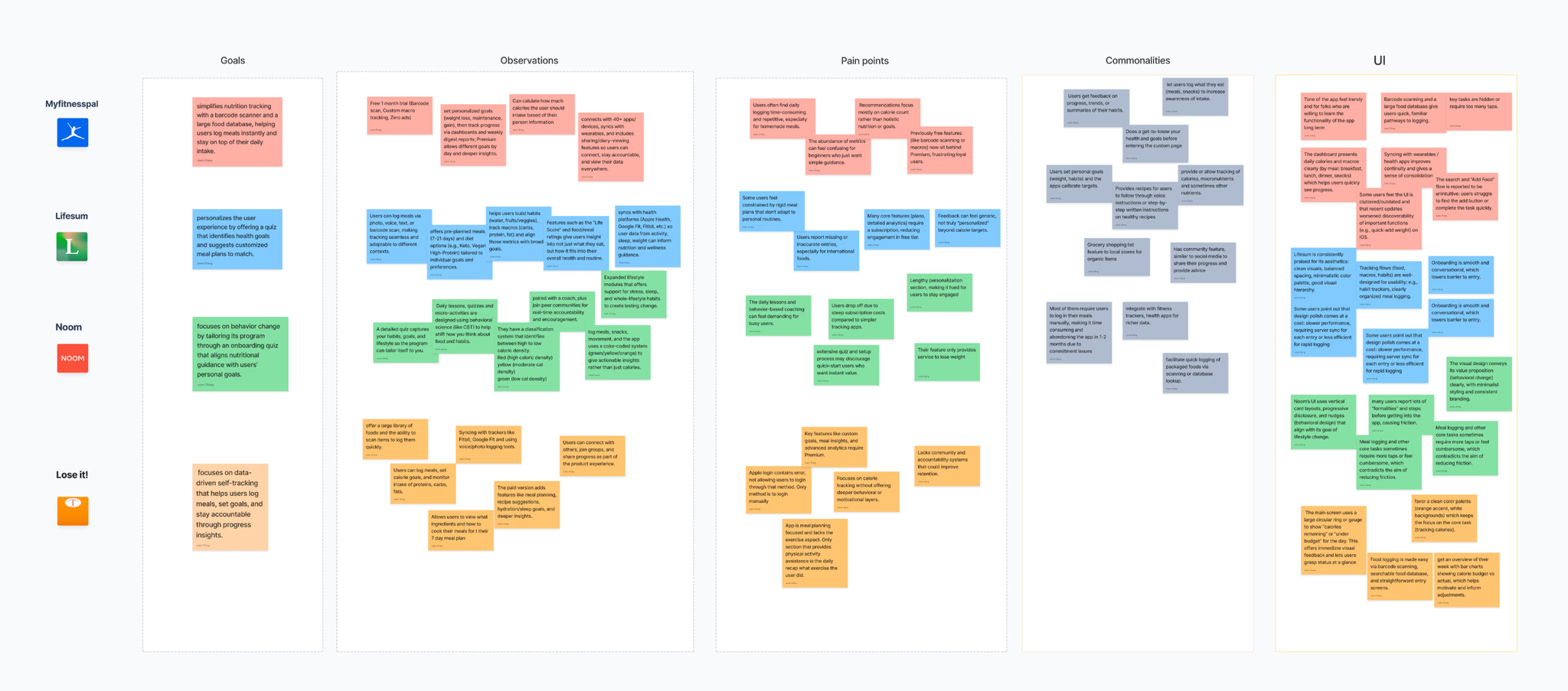
Competitive analysis of 4 direct competitors lacking in assistance and unique approach which helped guide our app's concept and vision. I found that there's a lack of assistance when users search for nutritional themed questions. These apps may seem like helpful tools, but they aren’t helping much with motivation, where consistency is a battle for most people.
I created an affinity map created to analyze our 4 competitors and identify user behaviors, pain points, and design patterns to shape NutritionNest’s direction.
GOAL
I proposed 3 main feature for our MVP
Based on our feedback from users, we learned that users struggled to stay motivated with meal logs due to the lack of personalization. Our proposed solution is to focus on features that consisted of customization, engagement, and AI personalization.
Customizable
Personalized experiences tailored to individual goals and preferences.
Engaging
Drive motivation and consistency through meaningful interaction.
AI Personalized
Deliver guidance powered by AI insights.
IDEATION
Mapping a clear, friction-free journey
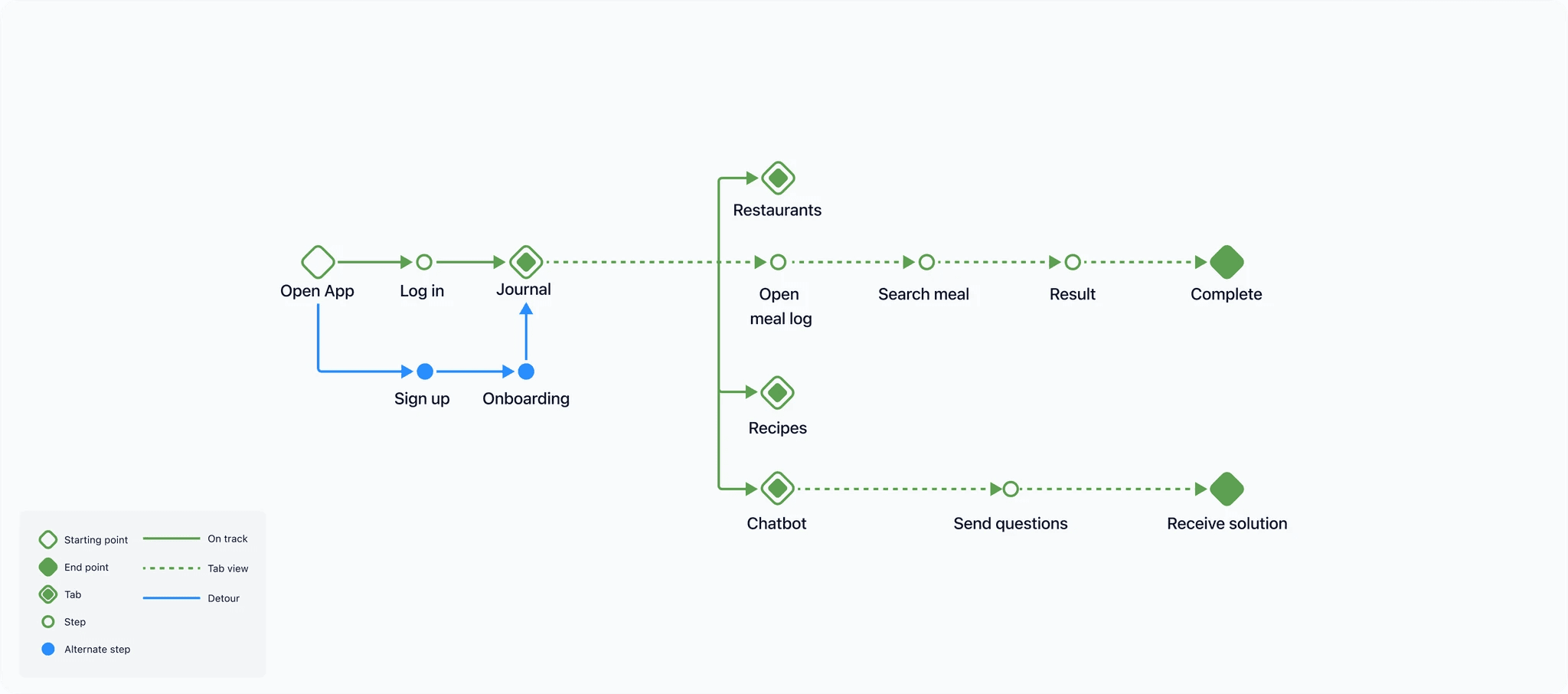
After aligning our goals, I mapped out a user flow to identify bottlenecks and key screens, such as an AI chatbot for personalized support, restaurant listings for healthier dining, a recipes for meal planning, and a user journal for tracking progress.
Leveraged user flow to identify potential bottlenecks and prioritize features for the app's overall structure.
EXPLORATION
I explored different design options to guide my vision to test out different visual approaches, allowing me outline the skeleton when structuring my visual hierarchy.
I explored different design approaches to understand how varying styles, structures, concepts, and constraints can shape the design trajectory.
LOW FIDELITY
Good start that helped our redirection
I shared early low-fidelity designs with the team, and while they liked the overall flow, they pointed out a couple of important issues. The floating action button made the interface feel cluttered, and AI wasn’t being used to its full potential—it was just a basic chatbot. Because of that, the app came across as just another meal-logging tool.
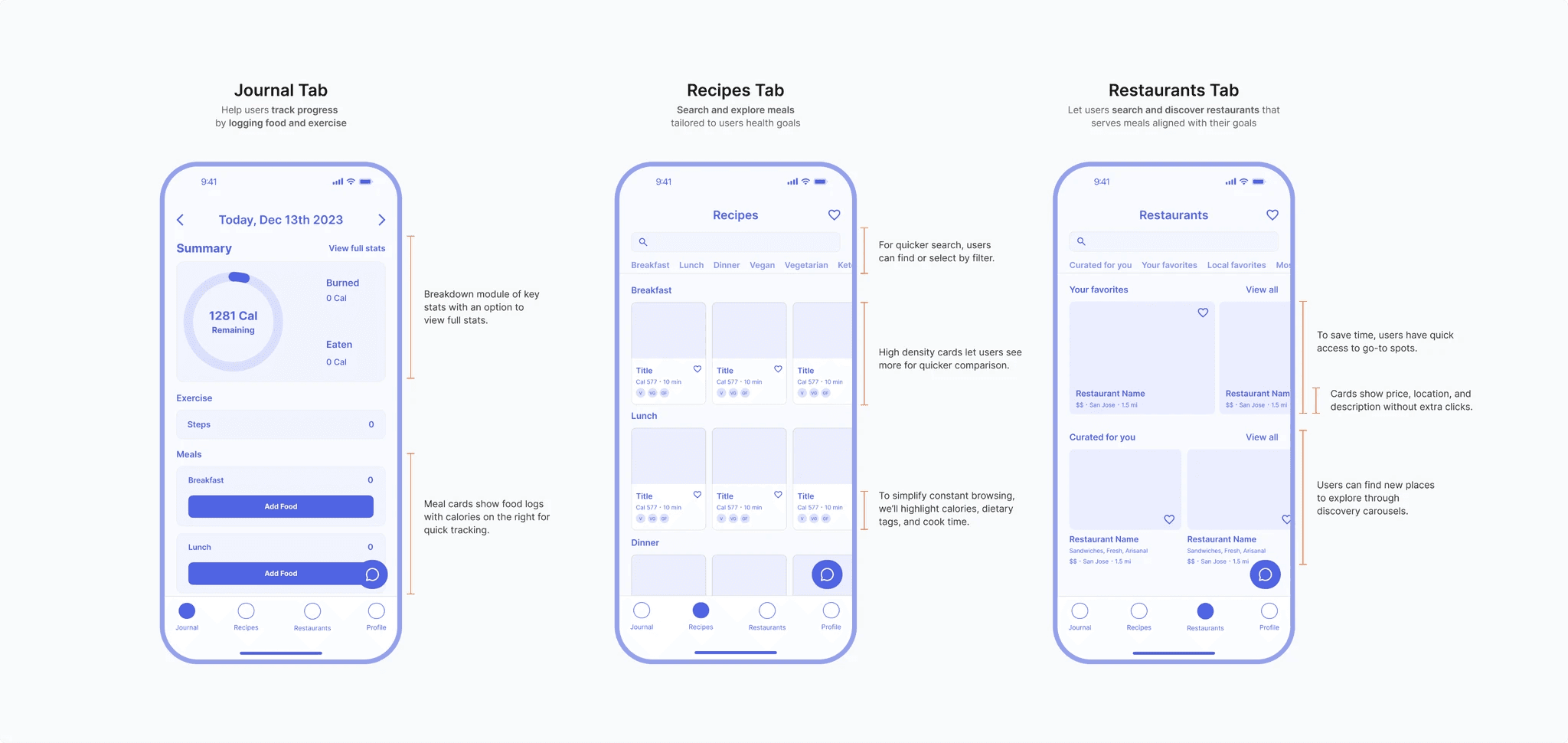
First stages of breaking down each tab's features with annotated labels to highlight key design elements and functionality, making them easier to digest.
Organizing content in second stage to make sure every design decision feels purposeful and helpful to the user on each screen. My Initial wireframes starting from log-in, progress-tracking journal, curated recipes, diverse restaurant options, and a floating chatbot button which made the UI feel crowded. AI feature was underutilized which felt like a typical meal-logging tool.
ITERATIONS
Introducing AI assistant, NED
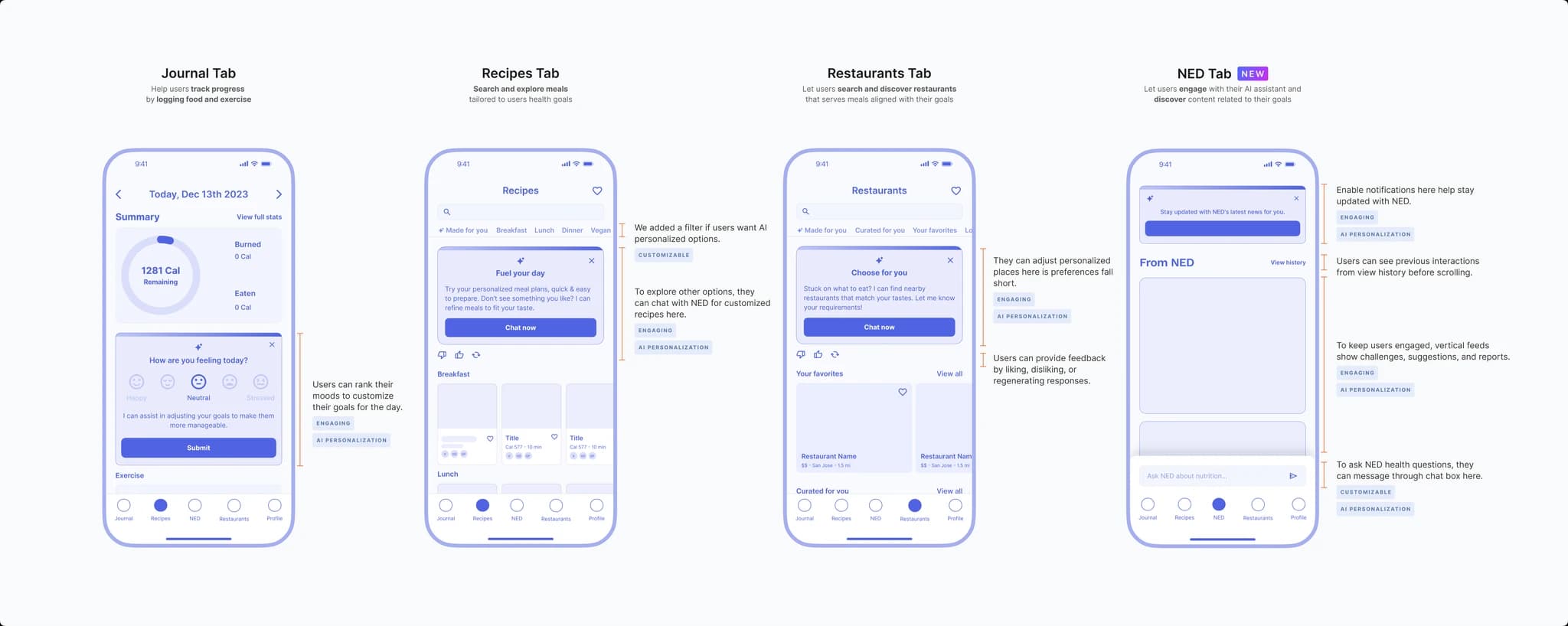
We made the chatbot feel more human by renaming it to 'NED,' adding NED cards throughout the app for better support, and giving NED its own tab for easier access. The design was a hit and got the green light to move forward!
Refined flow from journal, recipes, restaurants with NED fully integrated to provide personalized, nutritionist-like guidance. A dedicated NED tab delivers news, challenges, and real-time updates to stay informed and engaged.
SOLUTION
Final designs
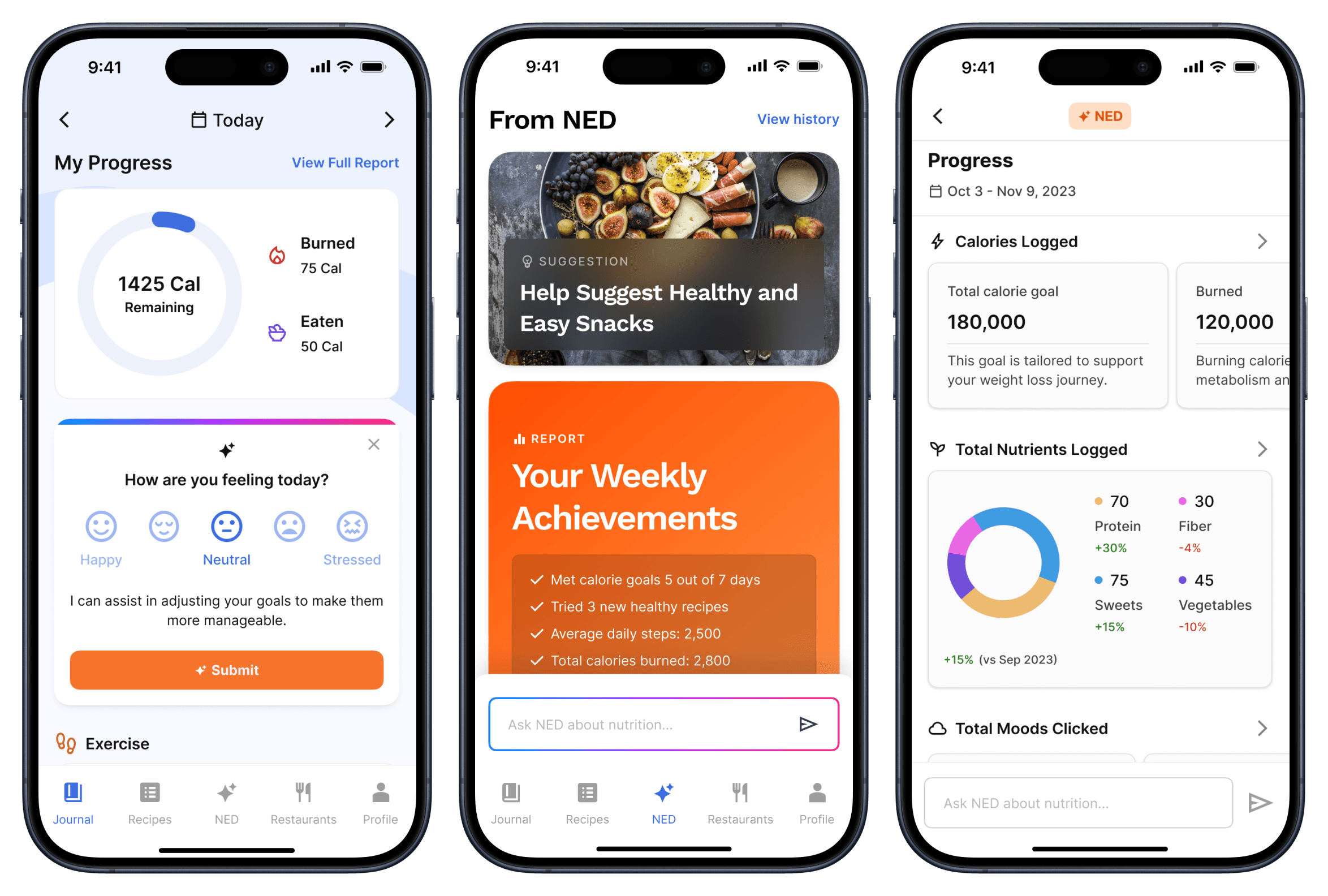
The final design circles back to its core mission providing a customizable and engaging design approach. From onboarding to finding recipes and restaurants, everything adapts to their preferences. NED cards keep users engaged with quick, AI-powered tips and calorie adjustments that fit their daily needs.
Customizable
Personalized experiences tailored to individual goals and preferences.
Engaging
Drive motivation and consistency through meaningful interaction.
AI Personalized
Deliver guidance powered by AI insights.
In our onboarding stage, users are greeted with a splash screen introduction along with log-in/sign-up, short 6-part questionnaire for a tailored, and final confirmation.
Here is the polished UI of journal, recipe, and restaurant tabs with dynamic NED cards, providing daily check-ins that create a personal support to drive accountability.
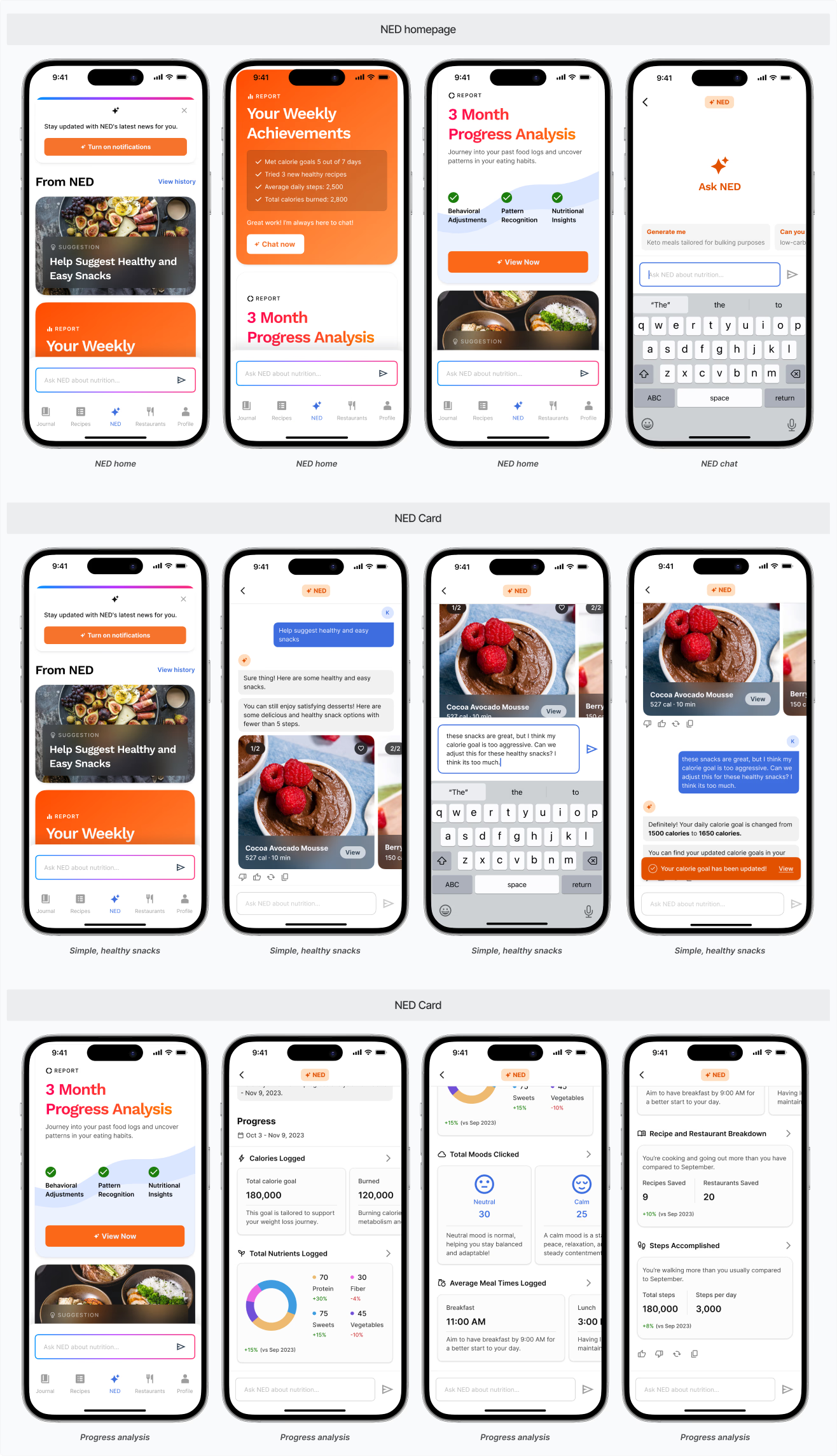
The NED page features a clean design with scrollable feeds that make it easy to dive into nutritional chats. We'll get inside look on three distinct NED cards highlighting simple, healthy snacks, 1-week of keto meals, and progress analysis. NED is here to support by boosting motivation and providing customizable features.
I used orange that serves as NED's primary color, contrasting with brand blue for buttons on NED cards. Secondary for softer colors, tertiary for icons, and vibrant gradient highlights AI moments, with neutrals providing balance.
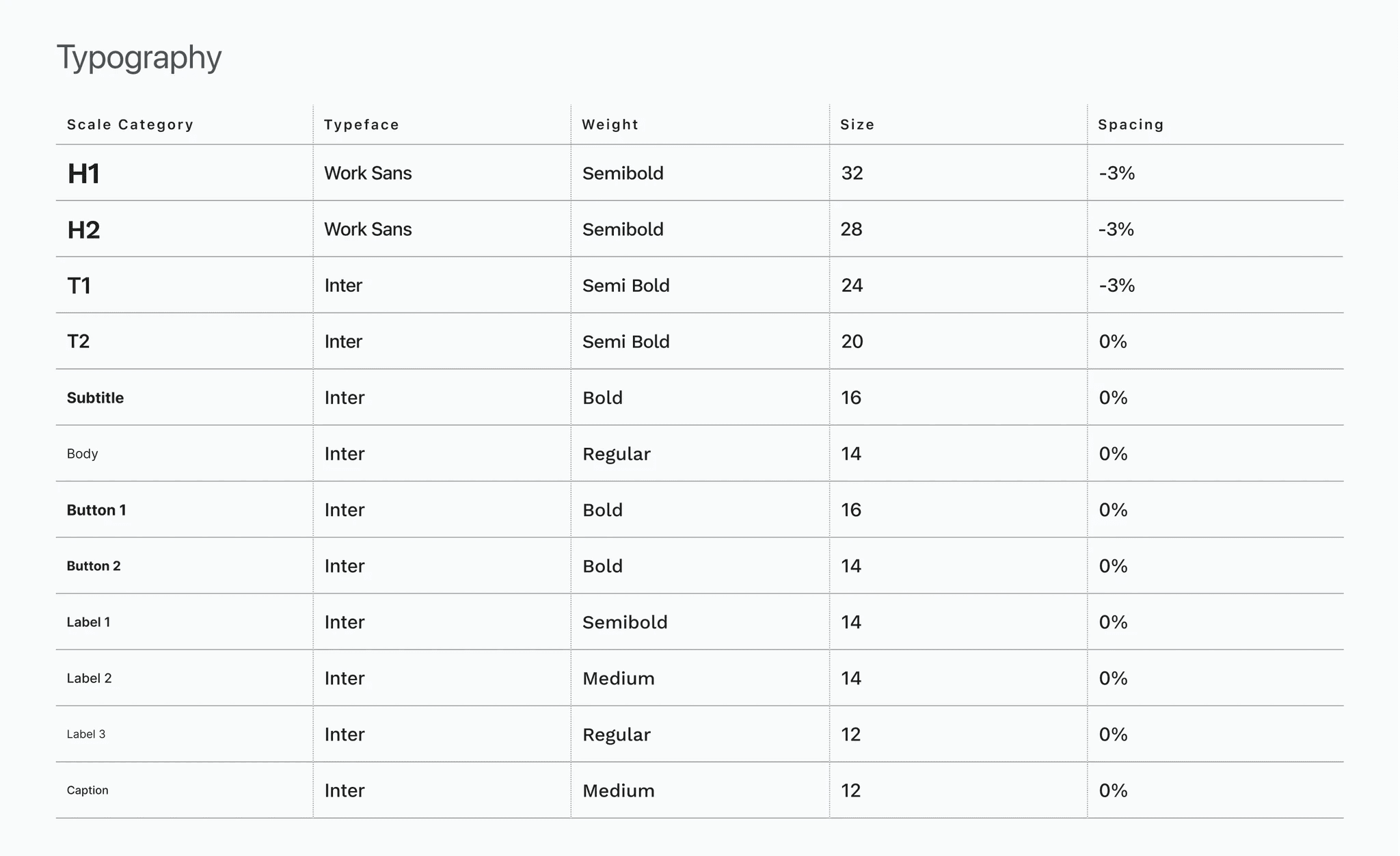
Work Sans is used for headers and expressive moments, ideal for quick readability. To contrast, I used Inter that's versatile for body text and product copy which seamlessly fits into the design.
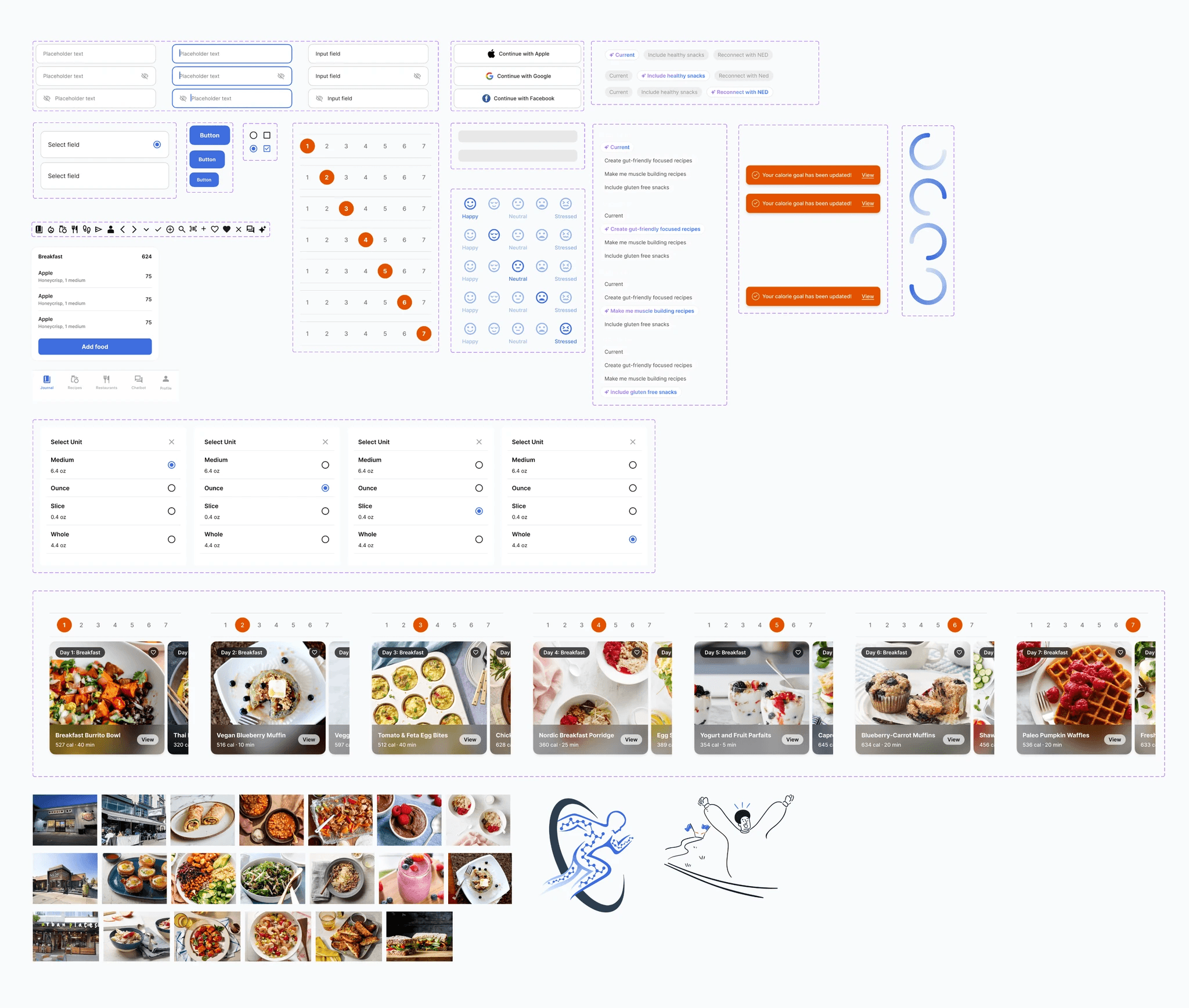
Full component library with all states complete, offering clear guidelines for our developer.
INTROSPECTIVE
Learnings
This process was challenging but learned so much. I gained valuable insights into what makes this app unique and learned the importance of clarifying business goals before diving into design. Understanding user pain points helped me re-evaluate critical design decisions, such as whether NED should remain in a chat room or be integrated throughout the app, ensuring that we address the right problems effectively.
Next Steps
If I had more time, I would track which NED touchpoints are most effective in engaging users and helping them achieve their goals. I would also brainstorm strategies to help users reach their nutrition goals faster. Additionally, I would identify underused features, evaluate their potential impact, and focus on enhancing the most valuable ones.